

The 1993 book “The Club Dumas” by Arturo Perez-Reverte served as the basis for the supernatural thriller “The Ninth Gate,” directed by the infamous Roman Polanski. In the 1999 movie, Johnny Depp’s Dean Corso, a book trader who uses dishonest tactics to achieve what he wants, is the primary character. Corso is hired by scholar Boris Balkan (Frank Langella) to authenticate his copy of “The Nine Gates of the Kingdom of Shadows,” which is thought to have been penned by the Devil, when his reputation quickly garners attention.
The Girl (Emmanuelle Seigner), a woman who exhibits an aptitude for the occult, becomes Corso’s ally as he gets entangled in a vast conspiracy throughout his search for answers. The film is undoubtedly weird and enigmatic, but that adds to “The Ninth Gate’s” appeal. Like many movies, nothing is explicitly explained to the audience; everything is left up to interpretation. The conclusion of “The Ninth Gate,” however, may be what makes it so memorable.
Corso discovers the dark meaning behind the engravings
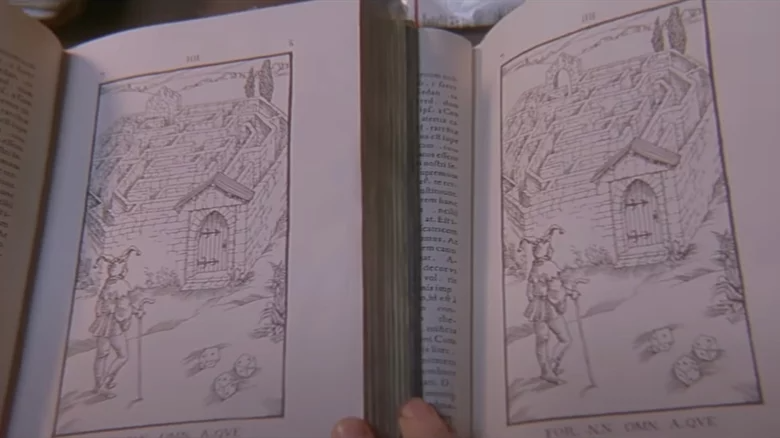 “The Ninth Gate,” at its core, is a detective thriller that begins with a probe. Balkan hires Corso to help him determine whether or not his copy of “The Nine Gates” is a fake. Balkan is eager to learn which book can genuinely call the Devil because there are only two other copies in existence. Corso accepts Balkan’s money and embarks on a trip to Europe in order to learn the truth, despite the fact that he is generally contemptuous of any topics pertaining to the paranormal.
The three books’ various interior engravings are one of the key mysteries surrounding them. The amount of photographs in each book is the same, but they are slightly different from one another. Corso analyses the engravings and notices that some of them have the marking LCF, which is obviously a reference to Lucifer, another name for the Devil. But when Corso digs deeper, he discovers that LCF’s engravings vary from book to book. Which book then is the right one?
They are all accurate. The summoning path is revealed when all of the LCF engravings from each book are combined. The only way to call forth Satan, if that is Balkan’s genuine intention, would be to collect all of the related engravings. But the truth remains a mystery. Does it prove the Devil is real if someone performs the procedure in accordance with the marked engravings?
Only Corso finds the secret to summoning the Devil

Corso’s mistrust is present throughout the majority of “The Ninth Gate.” He even sees Balkan’s ritual fail, which supports his assertion. This appears to be indisputable proof that none of the paranormal events have any significance. But Corso is shown to be mistaken at the movie’s climax. There is one reason why Balkan’s summoning was unsuccessful, and it had nothing to do with the Devil not existing. Corso discovers that one of Balkan’s engravings is a fake. Corso might be able to move on with his life and completely forget about his experiences. However, given everything he went experienced, he doesn’t really have a choice. After getting this far, Corso’s initial craving for money transforms into a desire for knowledge and solutions.
One of the first places Corso looks into has a divided engraving. The sight seems to persuade Corso that everything about the Devil he doesn’t want to accept is true when he sees it. He believes that the engraving, which shows the Girl in an image dated from the 1600s, proves the drawing’s authenticity. Being led by the Devil himself, Corso has the component that Balkan has been missing the entire time. Diverging from the conclusion of the novel, Corso next makes his way to a castle and passes through a gate that is illuminated, which many interpret to be the “Ninth Gate” itself.
Corso may be seen advancing toward the gate in the drawing in the final image, but does he finish the ritual? The appeal of the movie is that it is up to the audience to determine whether Corso will ultimately follow the road of evil and sell his soul to Lucifer, or whether something else will happen to him. Of course, much like Corso, the audience spends the majority of the film having doubts about everything, but despite everything, “The Ninth Gate” leaves enough questions open for the audience to continue to have.
The subject of the Devil is up for debate
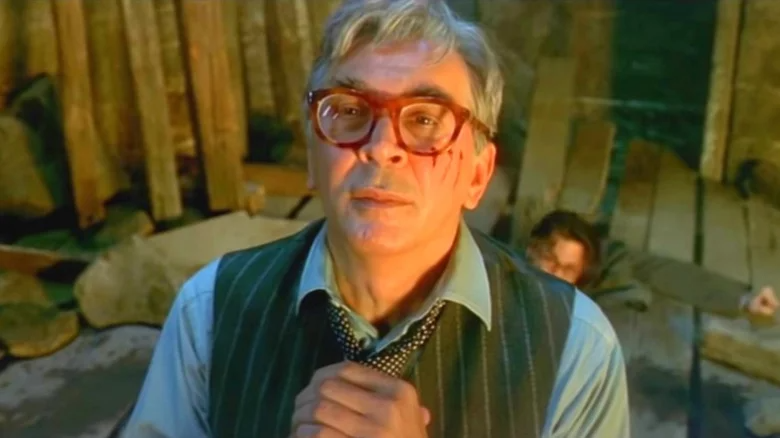 If Corso is certain of anything, it is that many people believe in the power of the Devil. The book seller first doesn’t appear to be a part of that group. Corso is shown as a purely self-interested sceptic. There is no disputing, however, that he encounters some paranormal activity as he looks into the meaning of “The Nine Gates.” He joins forces with the Girl along the way, who possesses supernatural powers including levitation and sparkling eyes. Corso, though, persists in favouring reason over superstition, and this comes to a head when Balkan acquires all of the engravings needed for the ceremony.
As Balkan begins to believe that he now possesses the ability to do the summoning, Corso watches in terror. Balkan’s pride overcomes him as he is encircled by a ring of flames. He approaches the flames, confident that he won’t get burned. But he is shown to be mistaken after dousing himself in gasoline. When he dies in the flames and Corso has to put him out of his pain, he only understands the ceremony was a failure. Then why does Balkan fall short? Is he simply not the one selected, or is everything a lie?
If the movie ended there, Corso’s suspicions would be proven correct: neither the Devil nor anyone who worships Lucifer are good people. The conclusion of “The Ninth Gate,” however, raises a number of issues that call this into doubt. Corso gains a great deal of knowledge in the movie’s closing seconds.
Who even is the Girl?
 The Girl is portrayed by Seigner as being so enigmatic that she is never even given a name. She nevertheless appears in each crucial scene of the movie. Corso doesn’t see her for days, but she always shows up when she’s required. The Girl supports Corso in his search for “The Nine Gates,” but she never fully reveals her motivations. However, there are a number of hints that can be used to determine who the Girl is, or at the very least, what she stands for.
The Girl is obviously from another planet. She has no name, but miraculously saves Corso whenever he needs her, and she directs him to the right engravings. This character is known as Irene Adler in “The Club Dumas,” which is a clear reference to Sir Arthur Conan Doyle’s character in “Sherlock Holmes,” a thief who, like the Girl, is cunning and deceitful.
The final engraving, however, provides the clearest indication of who the Girl is. When Corso discovers the final image, it shows a naked lady riding a beast with many heads, and the woman closely resembles the Girl. The Girl’s portrayal in the film suggests that she is intended to stand in for the complicated figure known as the “Whore of Babylon,” who is mentioned in the Book of Revelation of the Bible, and whose fall is symbolic of Babylon’s (via The Gospel Coalition).